



TRIFR Meaning: How to Calculate and Use Total Recordable Injury Frequency Rate

If you are managing operations or compliance across multiple sites, keeping track of safety performance is critical. But safety shouldn’t just be a compliance exercise; it’s about ensuring every contractor, supplier, and worker goes home safely while keeping your operations running smoothly.
One of the most common metrics used to measure safety performance is TRIFR, or the Total Recordable Injury Frequency Rate.
In this comprehensive guide, we will break down the TRIFR meaning, explain how to calculate it, and explore how enterprise leaders can use this metric to drive safer, more efficient site operations without adding administrative burden to their teams.
What is TRIFR (Total Recordable Injury Frequency Rate)?
TRIFR stands for Total Recordable Injury Frequency Rate. It is a standardised metric used to calculate the number of recordable workplace injuries that occur per one million hours worked over a specific period (usually 12 months).
By standardising the injury rate per million hours, TRIFR allows enterprises to accurately track their safety performance over time, regardless of whether their workforce grows or shrinks. It also provides a level playing field to benchmark your organisation's safety record against competitors and industry averages.
What counts as a "Recordable Injury"?
To accurately calculate your TRIFR, you must understand what qualifies as a recordable injury. Not every scrape or bruise makes the list. Generally, a recordable injury includes:
- Fatalities: Any work-related death.
- Lost Time Injuries (LTI): Injuries that result in the worker being unable to return to work for their next scheduled shift.
- Restricted Work Injuries (RWI): Injuries that allow the worker to return to work, but only in a limited or modified capacity.
- Medical Treatment Injuries (MTI): Injuries that require treatment from a medical professional beyond basic first aid (e.g., stitches, prescription medication, setting fractures).
What is excluded? Standard first-aid treatments, such as applying a simple bandage, using non-prescription medication, or cleaning a minor cut, are generally not included in your TRIFR calculation.
How to Calculate TRIFR: The Formula
Calculating your Total Recordable Injury Frequency Rate is straightforward once you have the right data. You need two key numbers from a specific time period (usually a rolling 12 months):
- The total number of recordable injuries.
- The total number of hours worked by all employees and contractors.
The TRIFR Formula:
IFR = (Total Number of Recordable Injuries × 1,000,000) ÷ Total Hours Worked
A Practical Calculation Example
Imagine you run a multi-site retail or construction enterprise. Over the last 12 months:
- Your workforce (including contractors) worked a combined total of 2,500,000 hours.
- During that time, you recorded 15 recordable injuries across your network of sites.
Using the formula:
- (15 injuries × 1,000,000) = 15,000,000
- 15,000,000 ÷ 2,500,000 hours worked = 6.0
Your TRIFR is 6.0. This means statistically, for every one million hours worked at your sites, 6 recordable injuries occur.
TRIFR vs. LTIFR: What is the Difference?
While researching safety metrics, you will likely encounter LTIFR (Lost Time Injury Frequency Rate). It is important not to confuse the two.
- LTIFR only counts injuries that result in lost time (the worker cannot return for their next shift).
- TRIFR provides a broader, more comprehensive picture because it includes lost time injuries, plus medical treatment and restricted work injuries.
Because it encompasses a wider range of incidents, an organisation's TRIFR will always be higher than its LTIFR.
Why Your TRIFR Score Matters for Enterprise Operations
For senior operations and compliance decision-makers, TRIFR is far more than a vanity metric. It directly impacts your enterprise’s bottom line, reputation, and risk exposure.
1. Contractor Pre-Qualification and Tendering
In industries like commercial construction, facilities management, and enterprise retail, your TRIFR is a key pre-qualification metric. Many top-tier enterprises will not award contracts to businesses with a TRIFR above a certain threshold. A low TRIFR proves you run safe, controlled sites.
2. Insurance Premiums
Workers' compensation and liability insurance providers look closely at safety metrics. A consistently high TRIFR suggests systemic operational risks, which often translates to higher insurance premiums.
3. Measuring Operational Inefficiency
Every recordable injury halts work. It triggers investigations, creates paperwork, and damages morale. A high TRIFR is a major leading indicator of operational inefficiency.
The Limitation of TRIFR: It is a Lagging Indicator
While TRIFR is universally used, it has one major limitation: it is a lagging indicator.
TRIFR tells you how many people have already been hurt. It looks backward. To effectively lower your TRIFR, enterprise managers cannot just look at past data; they need to focus on leading indicators, proactive measures that stop risks before an incident ever occurs.
This is where the traditional approach to site safety breaks down. If your enterprise relies on paper-based Safe Work Method Statements (SWMS) sitting in a contractor's glovebox, or if you have zero real-time visibility of who is actually on your site, you are exposed to significant risk. You cannot prevent incidents if you cannot see the hazards in real-time.
How to Lower Your TRIFR: 4 Strategies for Safer Sites
Reducing your TRIFR requires moving away from reactive paperwork and adopting operationally credible, real-time controls. Here is how leading enterprises are keeping things simple for workers on the ground while drastically reducing risk.
1. Automate Contractor Pre-Qualification
The easiest way to prevent a workplace injury is to ensure unqualified contractors never set foot on your site. Implement a system that verifies identity, licenses, insurances, and training certifications *before* a contractor arrives. When pre-qualification is automated, your enterprise risk lever is proactively managed.
2. Digitise and Geo-Fence Your SWMS
SWMS are a legal requirement for high-risk work, but a paper SWMS left in a vehicle is functionally useless and legally indefensible. By digitising SWMS and tying them to location-based geo-fencing, you ensure that hazard awareness is site-specific and completed at the exact location where the work occurs.
3. Deploy Electronic Work Authority Forms (eWAF)
For the retail and facilities management sectors, high-risk work (like electrical or working at heights) requires protective disclosure forms. Moving from PDFs to an automated eWAF system ensures workers understand the specific risks of the site they are standing on before they begin work.
4. Implement a Real-Time Incident Closeout System
When a worker flags a risk (e.g., answering "No" to wearing PPE on a digital checklist), it shouldn't disappear into a filing cabinet. It should trigger an automated alert to a supervisor. A strong Corrective and Preventive Action (CAPA) system tracks flagged items through to resolution with photo evidence, neutralising hazards before they impact your TRIFR.
How Site360 Makes Safety Reassuringly Simple
At Site360, we know that operations managers don't want another clunky software tool to learn. You want full visibility and audit-ready control across every site, without adding burden to anyone.
We built our platform to drive enterprise risk as close to 0% as possible, all while keeping the process dead simple for the worker. Here is how we differentiate from standard visitor management or compliance apps:
- Verifiable Geo-Fencing: Unlike basic QR codes that can be shared or scanned off-site, Site360 utilises patented geo-fencing. We verifiably prove a worker was physically on-site when they completed their SWMS or induction, making every record legally defensible.
- 100% "Done-For-You" Configuration: You don't have to build forms, inductions, or workflows. You tell us what your enterprise needs, and our team builds and configures it for you.
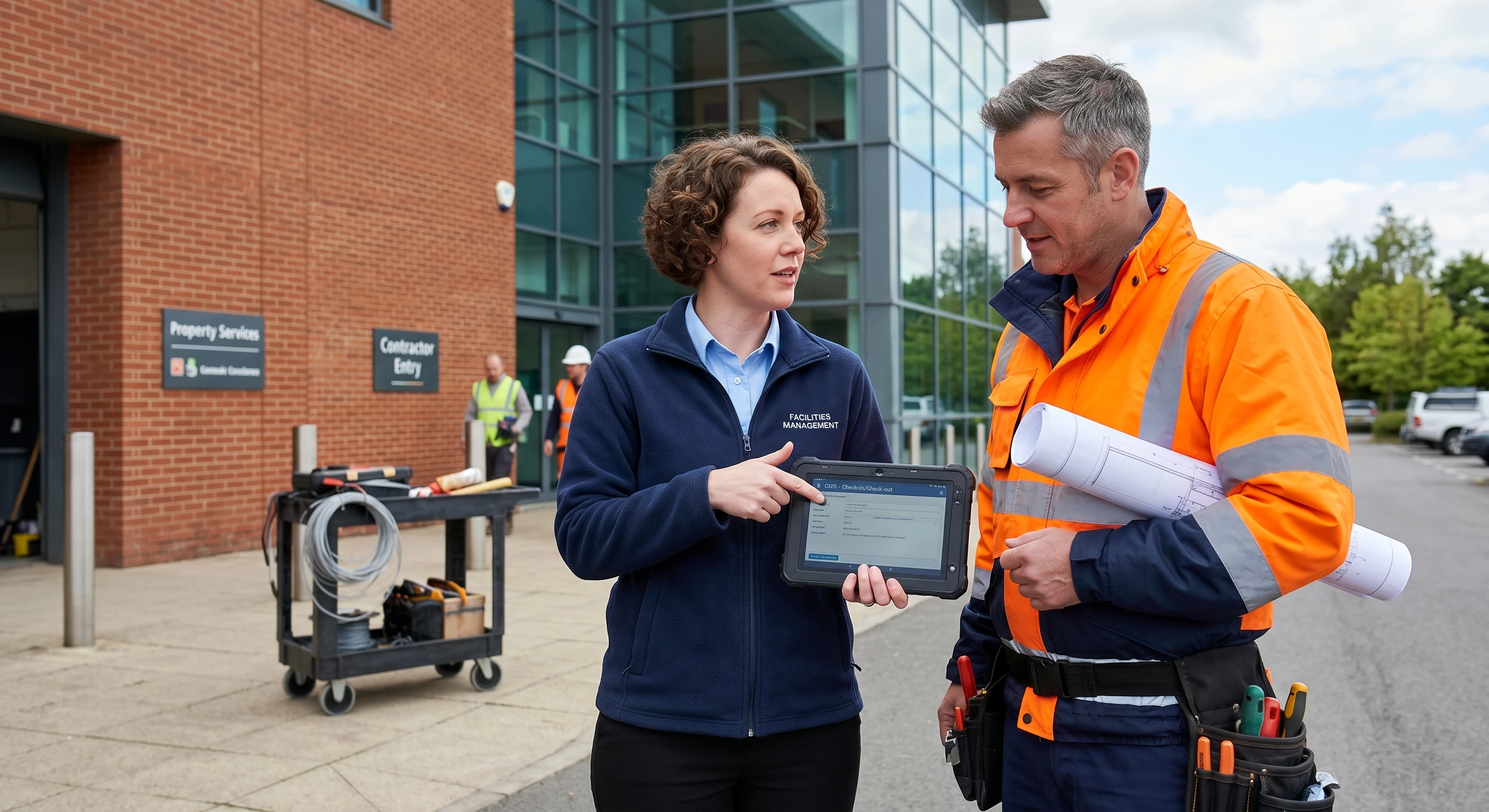
- Role-Based Simplicity for Workers: For the contractor, it’s effortless. They open the app and hit check-in. The system automatically delivers the site-specific inductions, SWMS, and electrical diagrams specifically relevant to their trade. No paperwork, no kiosks, no complexity.
- Real-Time Pre-Qualification & Flagged Alerts: We verify contractor credentials before they arrive. If an on-site checklist triggers a risk threshold, Site360 instantly alerts managers and tracks the incident to closeout.
Understanding the TRIFR meaning and knowing how to calculate your Total Recordable Injury Frequency Rate is the first step in measuring your enterprise's safety performance. But tracking past injuries won't protect your future operations.
To truly run safer, more efficient sites, you need real-time visibility, automated pre-qualification, and legally defensible, geo-fenced safety records.
Ready to gain audit-ready control over your entire network of sites? Stop chasing paperwork and start driving down risk. Discover how our done-for-you model can transform your site operations. Talk to Site360 experts today.
Frequently Asked Questions
What is a good TRIFR score?
A "good" TRIFR depends heavily on the industry. Office-based enterprises will naturally have a lower TRIFR than heavy construction or mining. Generally, a continuous year-over-year reduction is the primary goal, but industry bodies often publish annual benchmark reports for comparison.
Does TRIFR include contractors?
Yes. Best practice (and most regulatory reporting standards) require you to include all hours worked and all recordable injuries for both direct employees and contractors on your sites.
How do you calculate hours worked for TRIFR?
If exact timesheets are not available (which is common with transient contractors), enterprises usually estimate hours. For example, multiplying the number of daily contractor check-ins by an average 8-hour shift. Using a geo-fenced platform like Site360 automatically tracks exact check-in and check-out times, removing the guesswork from your TRIFR calculations.





_%20Definition%2C%20Calculation%2C%20and%20Examples.jpg)

_.webp)

%20A%20Guide%20for%20Construction%20(Hero).webp)
.png)












.jpg)