

If you manage multiple sites, contractors, or construction projects, you are likely all too familiar with the operational headache of compliance paperwork. Among the most critical, yet frequently mismanaged, documents is the Safe Work Method Statement (SWMS).
In theory, a SWMS is a vital safety tool designed to keep workers safe during high-risk tasks. In reality? It’s often a crumpled piece of paper sitting in a contractor’s glove box, or a generic, copy-pasted PDF that offers zero real-world protection and massive non-compliance risk for the enterprise.
So, what exactly is a SWMS, why is it essential, and how can you manage it without adding an administrative burden to your site managers and contractors?
In this guide, we’ll explain the fundamentals of a Safe Work Method Statement and show you how to move away from paper trails toward a simple, legally defensible, and operationally effortless digital process.
What is a Safe Work Method Statement (SWMS)?
A Safe Work Method Statement (SWMS) is a formal document required for High-Risk Construction Work (HRCW). It outlines the high-risk activities being carried out at a workplace, the hazards arising from these activities, and the specific control measures that will be put in place to manage those risks.
Think of it as a clear, step-by-step safety roadmap. It ensures that before a worker picks up a tool or starts a job, they have acknowledged the risks and agreed to the exact methods required to perform the work safely.
The Difference Between a SWMS and a JSA
People often confuse a SWMS with a JSA (Job Safety Analysis). While both assess risk, a JSA is generally used for specific, individual tasks to identify hazards before they happen. A SWMS is a legal requirement specifically mandated under Work Health and Safety (WHS) regulations for high-risk construction work.
Read more about: SWMS vs JSA: What's the Difference and When to Use Each?
When is a SWMS Required?
Under Australian WHS legislation, an SWMS must be prepared before any High-Risk Construction Work (HRCW) commences. This includes, but is not limited to, work that involves:
- A risk of a person falling more than 2 meters (e.g., scaffolding, roofing).
- Telecommunications towers or structural alterations requiring temporary support.
- Demolition of load-bearing structures.
- Work in or near confined spaces, shafts, or trenches deeper than 1.5 meters.
- Work on or near energised electrical installations or services.
- Work in areas with artificial extremes of temperature, compressed air, or near hazardous chemicals.
- Work on or adjacent to roadways or railways used by road or rail traffic.
If a contractor is performing any of these tasks on your site, a valid, site-specific SWMS must be in place, reviewed, and signed before work begins.
What Must a SWMS Include?
To be compliant, an SWMS cannot be a generic, vague document. It must be specific to the site and the exact work being performed. A compliant SWMS must:
- Identify the work: Clearly state what high-risk construction work is being done.
- Specify the hazards: Detail the health and safety risks associated with that work.
- Describe the control measures: Clearly outline how these risks will be controlled or minimised.
- Assign responsibility: Detail how the control measures will be implemented, monitored, and reviewed, and who is responsible for doing so.
Crucially, a SWMS must be site-specific. A contractor cannot simply use the exact same document for Site A and Site B if the environmental hazards differ. This is where traditional SWMS management completely falls apart.
The Problem with Traditional SWMS Management
For most enterprises and mid-market organisations, managing SWMS is an operational nightmare. The core problems include:
- The "Glove Box" Problem: Contractors often complete a paper SWMS and leave it in their van. If an incident occurs or an inspector arrives, the document isn't actually on-site.
- Lack of Real-Time Visibility: Head office and operations managers have zero real-time visibility into whether a contractor currently working on a site has actually signed the SWMS.
- Generic, Non-Compliant Forms: Workers often rush through paperwork, signing generic SWMS that haven't been tailored to the specific hazards of the site they are standing on.
- No Legal Defensibility: Paper forms and standard QR-code digital forms are easy to forge. A worker can scan a QR code from their couch, sign the SWMS, and claim they assessed the site. If an incident goes to court, you have no verifiable proof that they were physically present when they completed the document.
These issues create immense enterprise risk exposure. You have contractors performing high-risk work without verified compliance, and site managers wasting hours manually chasing paperwork instead of managing site operations.
How to Make SWMS Compliance Easy (and Legally Defensible)
Safety and compliance shouldn't mean adding friction to a worker's day, nor should it require a law degree for a site manager to enforce. The goal is to drive risk as close to 0% as possible before a contractor ever sets foot on site, and make the on-site process dead simple.
Here is how modern, digitally mature operations are transforming SWMS management.
1. Digitisation with Auto-Population
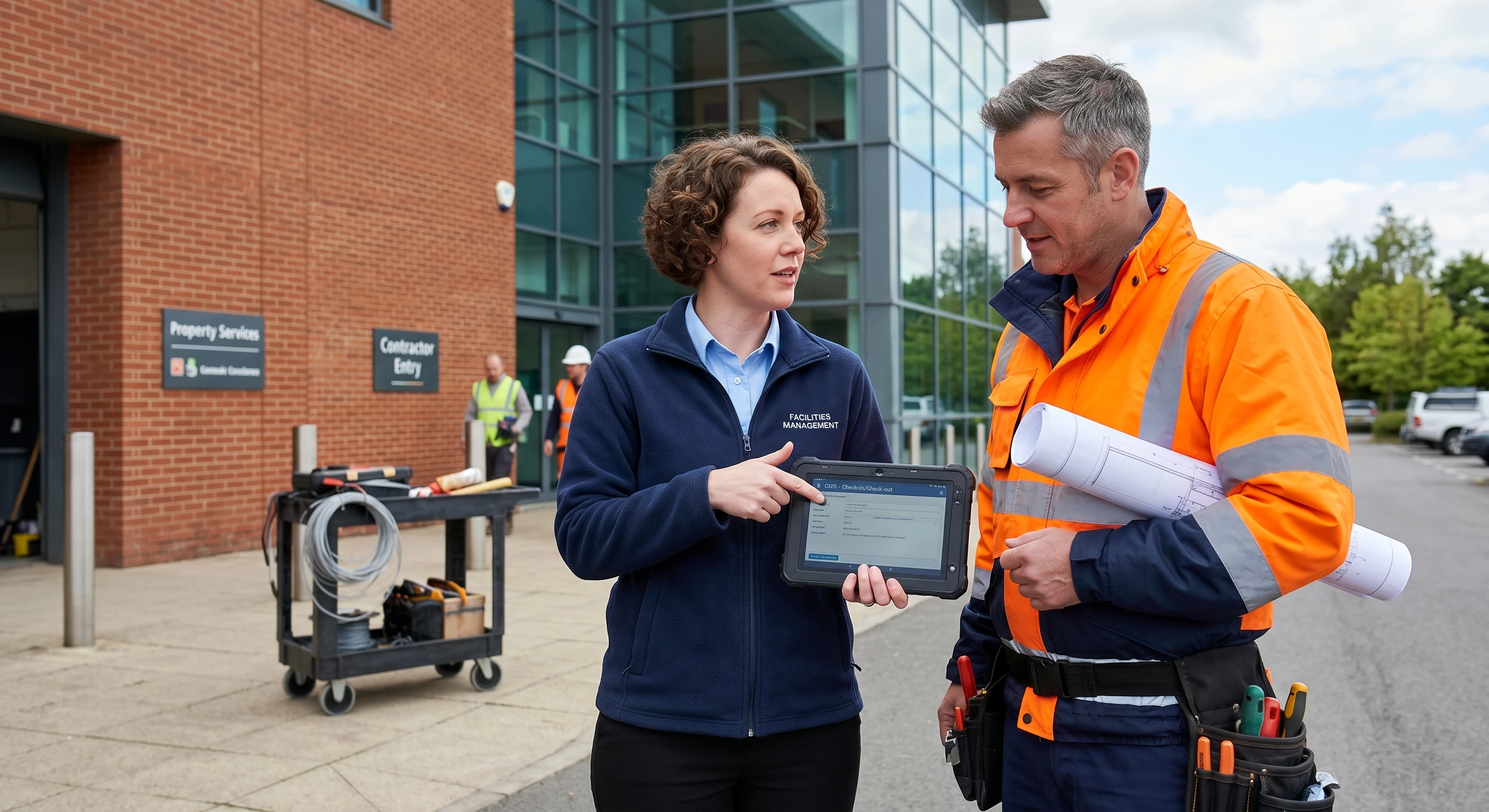
Instead of carrying clipboards, workers should be able to complete their SWMS digitally. Platforms like Site360 digitise the entire SWMS process. Because contractors are pre-qualified before they arrive, their details (insurances, licenses, certifications) are already verified. When they check in, the SWMS auto-populates with their data, saving them time and frustration.
2. The Power of Patented Geo-Fencing
This is the ultimate game-changer for legally defensible compliance. Unlike standard QR code systems (where codes can be photographed and scanned off-site), Site360 uses patented geo-fencing technology.
This is the ultimate game-changer for legally defensible compliance. Unlike standard QR code systems (where codes can be photographed and scanned off-site), Site360 uses patented geo-fencing technology.
When a worker opens the Site360 app to complete a SWMS, the geo-fence verifiably proves they are physically standing on the exact site. This makes the SWMS automatically site-specific. It captures the "who, where, and when" with pinpoint accuracy. The worker reviews the site-specific hazards, hits the sign, and gets to work. No paperwork, no kiosks, no complexity.
3. Real-Time Risk Flagging
If a worker completes a digital SWMS and answers "No" to an essential safety control (e.g., "Are you wearing a safety harness?"), the system should act immediately. With a smart platform, this triggers an automatically flagged item alert. It instantly notifies the relevant supervisor, creates a communication thread, and tracks the issue through to resolution with photo evidence. It functions as a proactive corrective and preventative action (CAPA) system.
4. A "Done-For-You" System
Most SaaS compliance tools hand you a blank slate and expect you to spend weeks building your own forms and workflows. Operations managers don't have time for that. Site360 builds and configures everything, from your site-specific inductions to your digital SWMS and alert workflows, on your behalf. You outline your operational needs, and the system is custom-built for you. No learning curve, just immediate operational control.
Safer Sites Without the Burden
Understanding "what is a SWMS" is only the first step. The real challenge is managing them effectively across multiple sites without drowning in paperwork or exposing your enterprise to unseen risks.
A Safe Work Method Statement is too critical to be left in a glove box. By leveraging a centralised, geo-fenced platform, you can give your head office audit-ready visibility, free your site managers from paper-chasing, and give your workers a dead-simple check-in experience.
Ready to see how easy site compliance can be? Site360 gives multi-site enterprises real-time visibility and control over every contractor and visitor. With patented geo-fencing and a "done-for-you" setup, we ensure every SWMS is site-specific and legally defensible. Book a Site360 demo today and take the friction out of your site operations.
Frequently Asked Questions
Do I need a SWMS for all construction work?
No. A SWMS is only legally required for High-Risk Construction Work (HRCW). However, many principal contractors mandate them as best practice for other potentially hazardous tasks to maintain strict safety standards across their sites.
Who is responsible for preparing a SWMS?
The person conducting a business or undertaking (PCBU) that carries out the high-risk construction work is responsible for ensuring the SWMS is prepared. If you are a subcontractor doing the work, you prepare it. If you are the principal contractor, you must ensure the sub-contractor provides a valid SWMS before they start.
How often should a SWMS be reviewed?
A SWMS must be reviewed (and revised if necessary) if the scope of work changes, if control measures are found to be ineffective, or if a new hazard is introduced to the site. Digital SWMS platforms make this easy by allowing real-time updates that instantly sync to the worker's app.





_%20Definition%2C%20Calculation%2C%20and%20Examples.jpg)

_.webp)

%20A%20Guide%20for%20Construction%20(Hero).webp)
.png)












.jpg)