


%20A%20Guide%20for%20Construction%20(Hero).webp)

If you manage construction sites, you already know that a ticket or a license doesn’t always guarantee a worker’s actual skill level. A contractor might hold a high-risk work license they obtained five years ago, but do they have the current, practical ability to operate that machinery safely on your site today?
This gap between holding a qualification and being practically capable is exactly why Verification of Competency (VOC) exists.
But while VOCs are critical for keeping sites safe and reducing enterprise risk, managing them often turns into an operational nightmare of chasing paperwork, lost records, and unverified contractors showing up at the gate. In this guide, we will explain exactly what Verification of Competency is, why it matters in construction, and how modern site operations platforms make it incredibly easy to manage without adding a burden to your site managers or workers.
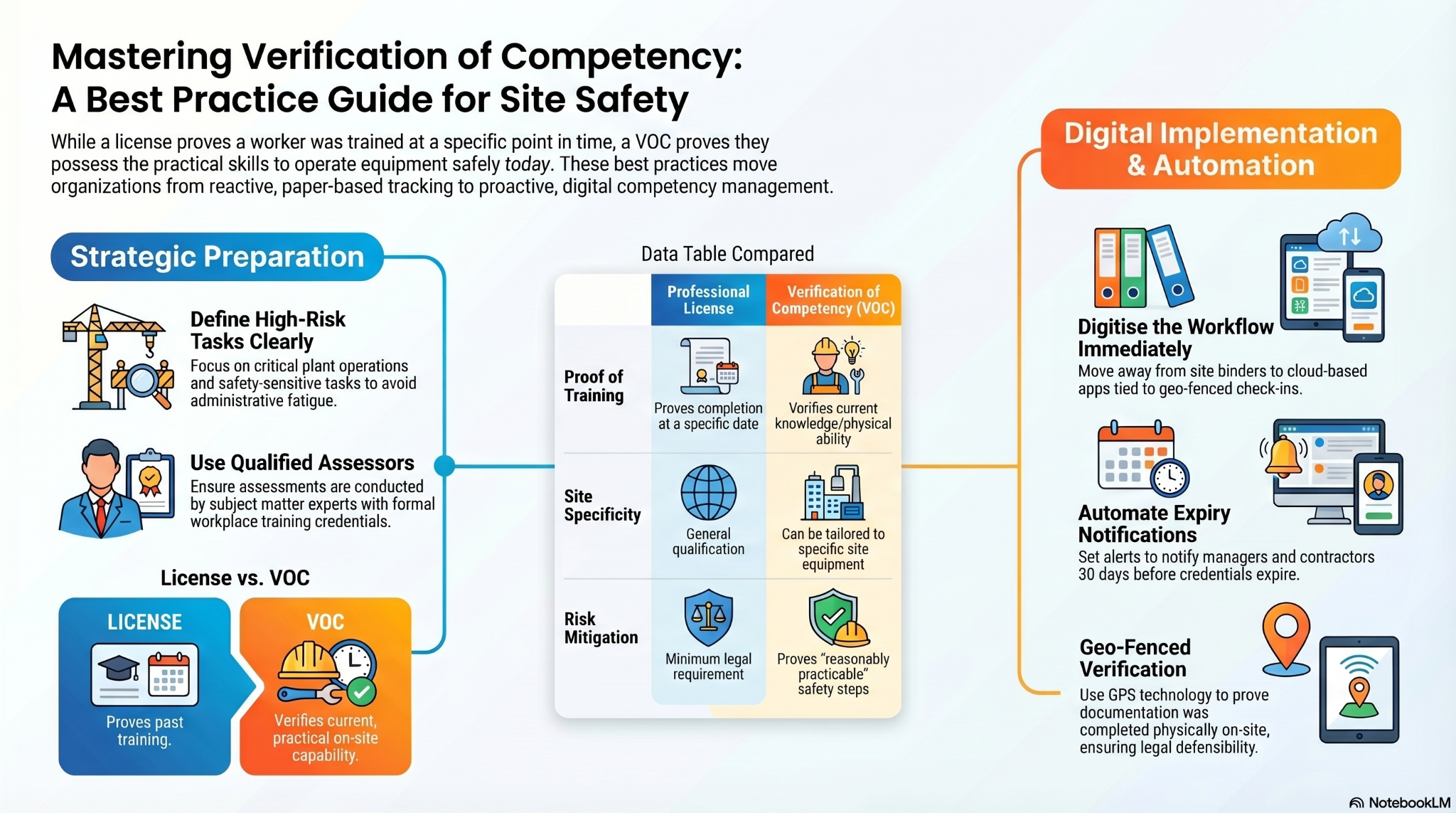
What Is Verification of Competency (VOC)?
Verification of Competency (VOC) is a method of assessment used to ensure that staff and contractors are competent to operate equipment or perform specific tasks. It is a proactive approach to site safety that goes beyond simply checking a piece of paper or a plastic card.
While a license proves that a worker completed the required training at a specific point in time, a VOC proves that they still possess the required skills, knowledge, and physical capability to perform the work safely right now.
In the construction industry, VOCs are commonly required for:
- Heavy machinery operation (e.g., excavators, cranes, forklifts)
- High-risk work (e.g., working at heights, scaffolding, confined spaces)
- Specialised electrical or plumbing work
- Using specific power tools or site-specific equipment
Why is VOC Critical for Construction Sites?
Bridging the Gap Between a Ticket and True Skill
Skills fade over time. A worker who passed a forklift driving test a decade ago but hasn't driven one since is technically licensed, but operationally high-risk. Regular VOC assessments bridge this gap, ensuring that every person operating heavy machinery or performing high-risk tasks is actively competent.
Reducing Enterprise Risk Exposure
For senior operations and compliance decision-makers, risk management is paramount. If an incident occurs on-site and the operator involved only had an outdated ticket without a recent VOC, the enterprise faces severe legal, financial, and reputational exposure. Ensuring VOCs are up-to-date proves that the organisation took all reasonably practicable steps to ensure site safety.
Driving Safer Daily Operations
When you know exactly who is competent to do what, site managers can confidently allocate tasks. It removes the guesswork and creates a culture of genuine safety, rather than just ticking a compliance box.
The Traditional Challenge of Managing VOCs
While the concept of VOC is straightforward, the execution on a busy construction site with multiple subcontractors is often chaotic. Typical pain points include:
- Paperwork bottlenecks: Binders full of VOC forms sitting in a site office, completely disconnected from the reality of who is working on the site that day.
- Zero real-time visibility: Operations managers at the head office have no way of knowing if the crane operator currently working on Site A actually had their VOC verified this morning.
- The glove box SWMS: Just like Safe Work Method Statements (SWMS) that are left in the glove box of a ute, VOCs are often treated as an afterthought—completed long after the work has started, or sometimes forged.
- Operational inefficiency: Site managers waste hours manually chasing contractors for their credentials, delaying the start of actual work.
How to Simplify Verification of Competency Without the Paperwork
The goal is to run safer sites without adding an administrative burden to anyone. This is where moving away from manual paper checks and basic visitor management tools becomes essential. Here is how enterprise construction firms are solving the VOC headache using intelligent site operations platforms like Site360.
1. Pre-Qualification: Stop Risk Before It Reaches the Gate
The most effective way to manage a VOC is to handle it before the contractor even sets foot on site. Through robust pre-qualification, you can verify a worker’s identity, licenses, insurances, and VOCs digitally.
If a worker does not have a valid, up-to-date VOC attached to their profile for the specific machinery they are assigned to operate, they simply cannot check in to perform that task. This shifts risk management from a reactive site-level problem to a proactive enterprise-level control.
2. Geo-Fenced, Site-Specific Verification
One of the biggest issues with standard QR code check-ins is that they can be spoofed. A worker can text a photo of a QR code to a mate who signs in from a coffee shop.
Using patented geo-fencing technology, platforms like Site360 verifiably prove that a worker was physically on-site when they checked in and acknowledged their competencies or completed a site-specific SWMS. This makes every record legally defensible and completely eliminates "ghost" sign-ins.
3. Real-Time Oversight and Role-Based Access
When a worker checks in via a geo-fenced app, the system knows who they are, what trade they belong to, and what their competencies are. If they are an electrician, they are automatically presented with the electrical wiring diagrams and relevant safety forms. If their VOC is missing or expired, an alert (Flagged Item) is immediately sent to the site manager. Everything is tracked through to resolution with a full communication thread, functioning as an automated corrective and preventative action (CAPA) system.
4. Done-For-You Configuration
Implementing a new system shouldn't mean spending months learning how to build forms. The best approach for busy ops managers is a "done-for-you" model. You hand over your VOC requirements, SWMS formats, and site rules, and the platform builds and configures the workflows, alerts, and inductions for you. Your site managers don't learn a new software suite; they just get a system that works on day one.
Best Practices for Implementing VOCs on Your Sites
- Define High-Risk Tasks Clearly: Don't require a VOC for every minor task. Focus on high-risk plant operations and critical safety tasks to avoid administrative fatigue.
- Use Qualified Assessors: Ensure that the person conducting the VOC is a subject matter expert with the relevant workplace training and assessment credentials.
- Digitise Immediately: Move away from paper. Use a cloud-based app that ties a worker's VOC directly to their daily geo-fenced check-in.
- Automate Expiry Alerts: Set up your platform to automatically notify both the contractor and the site manager 30 days before a VOC or license is due to expire.
Verification of Competency is a non-negotiable part of modern construction safety. It protects the worker, the site manager, and the enterprise by ensuring that the person behind the controls is genuinely capable of doing the job safely today.
However, managing VOCs doesn't have to mean drowning in paperwork or slowing down site operations. By leveraging pre-qualification and geo-fenced site operations platforms, you can gain full visibility and audit-ready control across every site in real-time.
Ready to simplify your contractor compliance and drive risk to zero before workers even step on site? Discover how Site360’s done-for-you, geo-fenced platform gives you total control over your site operations. Contact us today to see how we make managing VOCs, SWMS, and site inductions effortless.
Frequently Asked Questions
Is a VOC a legal requirement in Australia?
While WHS legislation does not explicitly use the term "VOC" in every instance, it mandates that employers must provide necessary information, training, instruction, and supervision to protect workers from risks. Conducting a VOC is the most practical and defensible way to prove you have met this legal obligation.
How often should a VOC be conducted?
Industry best practice suggests conducting a VOC whenever a worker is hired, when they return from an extended period of leave, when new equipment is introduced, or typically every 1 to 3 years, depending on the risk level of the equipment.
What is the difference between a license and a VOC?
A license is a formal qualification issued by a regulatory body proving that training was completed. A VOC is a practical, current-day assessment verifying that the worker still retains the skills to operate safely on a specific site.






_%20Definition%2C%20Calculation%2C%20and%20Examples.jpg)

_.webp)

.png)













.jpg)